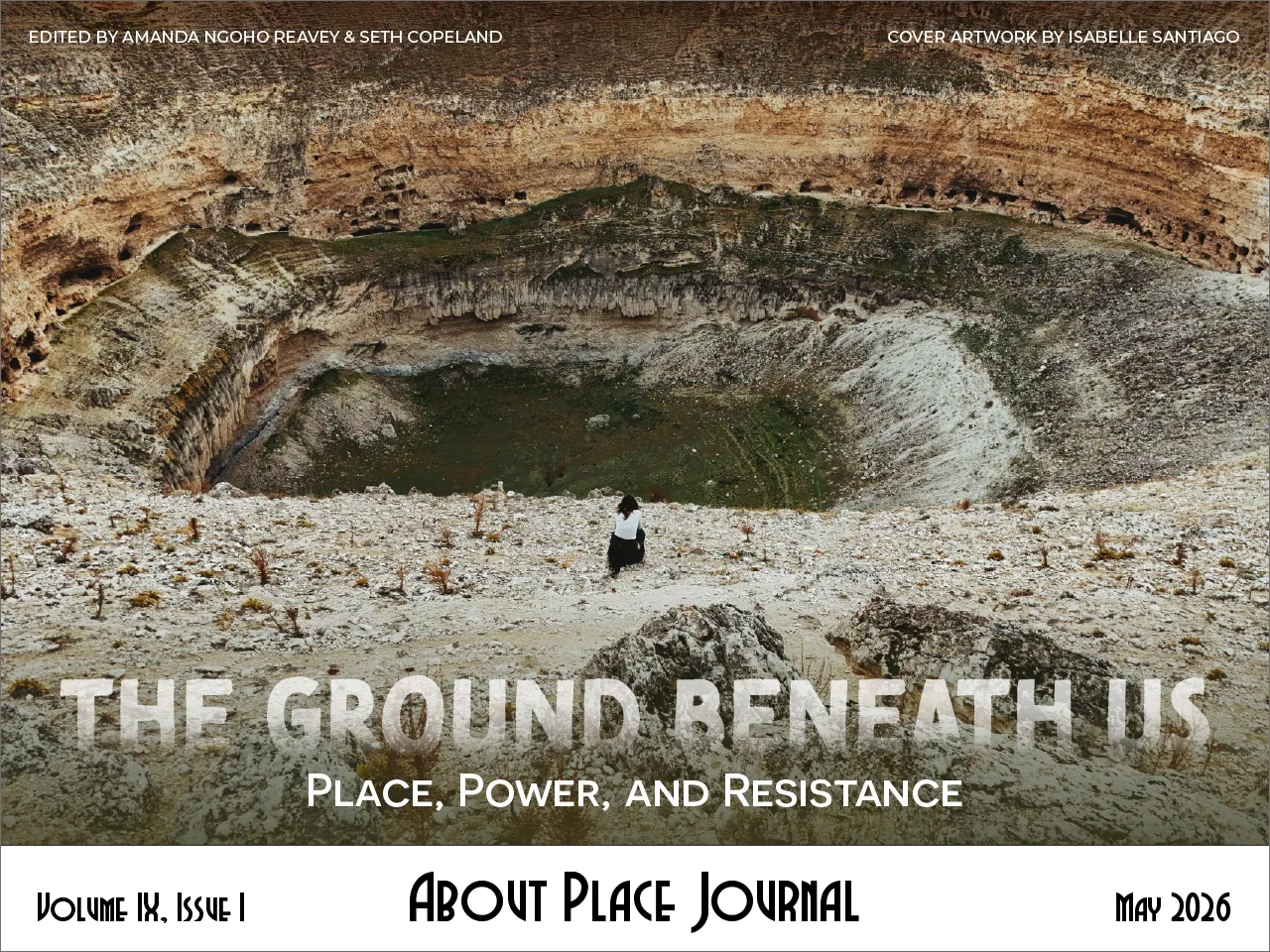
We are living through a time when place is increasingly contested through displacement, environmental destruction, state violence, and the ongoing legacies of colonialism. Land, home, and community are not neutral spaces: they are sites where power is exercised and where resistance continues to take root.
We do not arrive in place as strangers. We arrive inside histories already written into the soil, the pavement, the water, and the air. Every landscape is shaped by what has been taken, what has been defended, and what refuses to disappear. To move through a place is to move through layers of grief, memory, and struggle that are still unfolding beneath our feet.
This issue of About Place Journal emerges from a shared recognition: place is never just geography. It is a relationship between people, land, memory, and power. It is shaped by struggle and sustained through care, and it holds both the weight of loss and the possibility of transformation. The work presented here documents human experience & engagement with place stretching back centuries, from the Second World War to Gaza. Despite geographical dispersion, the resonance and echoes between works from Turkey to Nigeria, from Mexico to Palestine, from Iran to Indigenous America, are undeniable. These struggles are eternal; many have worn different faces over the years.
Much of the writing in this edition is about a place where fascism presently bares its fangs with impunity: the United States of America. This nation has long posed as the Leader of the Free World, when it is in fact the Bully of the Free World, domestic and abroad. It endlessly politicizes Indigenous identity and land, as we see in the poems of Megan Wheeler and David Anson Lee. It empties coffers for the violence of wars abroad while allowing the violence inflicted on the unhoused and impoverished to go unchecked at home, as frankly reported in Amber Atiya’s “Post Shelter Journals” and s.b’s poem “cities of tents.” It professes free speech while actively eroding it, as Janine Certo’s “Abecedarian of Banned Words” shrewdly points out with words banned by this wicked administration. It has inflicted terror on its citizens, perpetuating a warzone in Minneapolis, as reported on in new essays from BEI Fellows Flo Golod and Brenda Peterson. It has done everything it can to eradicate LGBTQ+ people and continues to fail, as these powerful new poems from CAConrad profess with loud, defiant beauty.
If the US is the great villain of our times, the People still have their own work to do, and alternative ways to elevate; reminders that better worlds are not merely possible or inevitable, but also already here. DJ Lee’s lyric photo-essay “The Earth Darkens Where People Have Lived” reflects on Greenland’s Ilulissat rubbish heap, how generations past and present can be connected to the same responsibilities. And there is still joy to be had in things done well, in traditions stretching back before written history. Jonali Patgiri highlights the knowledge of fine turmeric passed down by the mothers and grandmothers of Meghalaya, India. Oluwafemi Amogunla’s photos of the Yemoja Festival in Ibadan, Nigeria, document the timeless Yoruba devotion to the connection of people and water even as landscapes are marred by global pollution. In “The Eloquence of Spirit and the Earth’s Power,” Inés Hernández-Ávila celebrates Indigenous relationships with the natural world, and the resistance to Eurocentric deconstructions. “The Earth comes first,” she writes. “Always.”
In the myth of Antaeus, the giant born of earth and water, Antaeus’s strength comes from his connection to his mother Gaia, the earth, the ground beneath him. Lifted up by Heracles, he loses his invincibility and is broken. We mere mortals—not giants, though sometimes heroes—have prepared for ourselves a deeper bed of strength. The ground beneath us lives in the languages it grows, in the names carried from one land to another, in the water that moves people over it and itself along. Place is physical and metaphysical: the solid earth and a state of mind. Reimagine maps, neighborhoods, and sacred ground in these thieving times. Fight for place while honoring those who fought before us. Carry in memory, blood, and spirit home and the places that mirror home. And when the claws come to pull us from the ground, resist.