We’ve been in the car for about two hours now, the Mediterranean sun scorching the napes of our necks. My soaked blouse sticks to my chest like wet paper on glass and sweat plasters baby hairs to my temples. Feet perched on the tiny elevated floor of the back middle seat, my aunt to my right and my cousin to my left, I fold myself in neatly like an umbrella. No matter how tight I squeeze, it’s useless. We Elhindis are known for flat bellies and big hips and the three of us fill every inch of the back of this tight, run-down rental. We are in one of those old cars that only have AC in the front and not in the back, as if backseat passengers are somehow inferior. And it is uncomfortably hot. Ninety-degrees-in-the-afternoon-sun hot. The kind of hot that feels like dense pudding you can’t wade through. The kind of hot that leaves you wordless and drained. Even with the windows rolled all the way down, we melt in our disdain for my dad, Baba. He sidestepped a roomier, cooler car for this one, scared his mother, my Sitti, would judge him for overspending.
Sitti sits in the front passenger seat with her sturdy body pressed against the window, majestically high cheekbones protruding from her profile. Eighty years of survival are visible in her gold-adorned, bony fingers with skin that folds over her knuckles like crinkled wax paper. In true Sitti fashion, she clutches the top grab handle. A habit that has irked my mother—an impeccable driver—since my earliest memories. “She holds onto that handle as if I’m about to kill her,” Mama would say.
Baba drives purposefully, searching. In his hand is a modern map traced with our village coordinates from a historic map. We circle the same roads along the Latroun – Yafa – Jerusalem route, unable to find the exit that should take us to Sitti’s village. Our ancestral village.
I know my days here are limited; I may never be allowed back. I fight time and motion to devour even the smallest detail of my surroundings. Never have I been immersed in such ethereal scenery. Having only lived in the orange, sandy deserts of the Levant and Arabian peninsula, I cannot fathom that such greenery could possibly be nestled between the arid climates of Giza and Jordan. The earth palpitates something otherworldly—almost godly. Sunlight filters through the trees, flirting with the shadows. Pomegranate, lemon, figs, and olives bloom over lattices of rustling leaves. Forests brim with sage and thyme. Homes dangle in the sky over green mountains carved with spirals of ancient stone, while Spanish-style terracotta roofs shimmer like jewels atop verdant hills. Foreign, invasive pines furnish the edges of endless, developed roads. A true wonder to behold that I almost forget the secrets these pines conceal: remains of many villages buried underneath.
***
Growing up, Sitti told us about her Palestine. During summer nights in Amman, my cousins and I gathered in Sitti’s home. We drew back the makeshift 80s-style lace curtain securing her storage closet and pulled out dusty floor mattresses laden with clashing paisleys and vintage florals. We dragged them to the living room floor, lined them up in two perfect rows, and plopped on top of them. Ten of us—aged five through seventeen—cross-legged and eagerly awaiting Sitti’s stories. She propped herself on a white plastic chair, hovering over us like a true Matriarch, white-and-black prayer beads methodically moving between her fingers as she remembered God. Through the windows, the crisp evening breeze cooled the insulated rooms, while the ceiling fan whipped the air above us. I always snatched the mattress closest to Sitti. With only one sheet for every two cousins, we snuggled closely and listened to every word Sitti uttered, without interruption. She is a hard woman of towering height, strong and lean build, and multiple wartime displacements, but speaking of her homeland softened her.
Sitti was born in Alqbab, Palestine in either 1929 or 1930; we don’t know for sure. In Sitti’s childhood, time wasn’t measured in precise dates, but rather seasons. Alqbab was a village located on a central coastal plain between Jerusalem and Ramleh. It boasted a population of a few thousand and was known to be home to a few large families, including ‘elet el-hindi or “the Hindi family.” We had been rooted in Alqbab for at least a couple centuries, spanning back at least ten generations. Although Sitti is the child of her father’s first wife, she is the youngest of her siblings and the only daughter—a miracle born to her mother after far too many miscarriages and stillbirths. She was known as Fatema alhamra, or “red Fatema,” due to her distinctly pale, reddish complexion—an anomaly among the pearly and olive tones surrounding her.
Both of my grandparents were Elhindis, but they weren’t really related. And like most of Alqbab’s population, they were farmers, or falahin. Two of Sitti’s brothers married two of my grandfather’s sisters, leaving a void in the field labor on my grandfather’s side of the family. To remedy this, Sitti’s parents recommended that Sidi, my grandfather, marry their only daughter. At the time, she was thirteen and he was twelve. For Sitti, “marriage” meant moving to Sidi’s house and living as a member of his family for many years. They wouldn’t consummate their marriage or take on true marital duties until their late teens.
At thirteen, Sitti’s first intimate relationship was with the earth. It gave her purpose. Inducted her into the collective. Every dawn, she awoke and immersed herself in the land alongside her new family, and her new best friend, Sidi. After the first rainfall of the season, she plowed, sowed, and harvested, bringing sustenance to her family and community. I always imagined the silk strands of her thick, luxurious auburn hair in the sun, bouncing off her back. Her long, reddish fingers lyrically and swiftly moving between the harp strings of the wheat stalks—each fallen wheatberry a tribute to the land and the generations that nurtured it.
Sitti lived in her beloved Alqbab for about eighteen years. Then, in the summer of 1948—around the creation of the state of Israel—Zionist militias gave my family mere moments to flee their homes. The massacres of Palestinians in nearby Lydd and Ramleh were warning enough. Soon after, though not without resistance from some of the villagers, the militias captured Alqbab. Flattened it. All evidence of Palestinian life effaced. My grandparents, expecting their first child, were forced to head east, to the West Bank, where they sought refuge in another Palestinian village on the outskirts of Ramallah. They eventually found themselves in refugee camps, the Atlantic Ocean, Managua, San Juan, Dallas, and Amman. They were never allowed to return home.
As Sitti orated her upbringing, I inherited her memories. She could tell my love for Palestine was different from her other grandchildren. I got lost in her stories about this mythical land and its fruits. Raised in New Jersey and then Riyadh, I never quite fit in. I longed for a homeland, especially as I pictured Sitti’s harrowing journey from her home, carrying a baby in her belly and belongings on her back, trying to wrap my mind around the injustice of it all. I imagined her hard life in the sheet tents of the refugee camp, where she birthed her second child, only to lose her first to a measles outbreak at the camp. I wondered where Sitti derived her resolve after such profound loss, how she simply carried on. I wanted to know everything about her. Everything about Palestine.
Every summer, I went to Amman and followed Sitti around, hungry for more stories, more history. I hung around her in the kitchen as she lathered raw chicken with olive oil and packets of Goya Sazon from Texas for her signature roast. I followed her to her backyard, under canopies of grape vines mixed with fresh laundry, where the ripeness of grapes softened the harsh scent of detergent. I sat across from her on the marbled veranda floor, while she sifted through bunches of mlukhiyeh leaves and I massaged the bunions that slanted her toes at a sharp forty-five degree angle.
Sitti told me of the simple things she missed before her exile. The taste of Palestine’s akkawi cheese. The aroma of grinding za’atar into fine powder and rubbing it with sumac. Pickling freshly picked produce. Rendezvous with other women to neighboring villages. Sitting in outdoor circles over candlelight, rapidly tapping hand drums and singing folk songs.
She talked about the village where my family sought refuge after dispossession in 1948. How its residents made them feel unwelcome, burdensome. She left them for overcrowded refugee camps, preferring the community she found among other displaced Palestinians. They mourned together. Looked after one another. Raised each other’s children. Shared limited rations of sugar, flour, and rice. Baked bread communally. Foraged dandelion greens. Picked fresh sage and mint for sweet hot tea—one of few familiar pleasures.
After Palestine, Sitti had a stint in Rome, where she had pasta for the first time. After two weeks of eating nothing else, she finally learned how to ask for risotto—a dish closer to the grains she grew up with: rice, maftoul, and freekeh. She lamented trading in her thobe, or traditional embroidered Palestinian dress, for a white suit when she moved to Managua. She similarly regretted eschewing her white scarf and long braid for a short bob—better suited to her new role as a modern woman running a business. She was illiterate but a wizard with numbers, bringing my family short-lived success before the Nicaraguan Revolution displaced my family once again in the late 70s. She moved to Amman where she returned to her roots. Never again would she let go of her thobe.
I was by no means Sitti’s favorite grandchild. But because I loved Palestine so much, she gave me one of her thobes when I was thirteen. She had worn it to my parents’ wedding and it was one of the only two Palestinian thobes she’d ever embroidered herself: a cherished heirloom from the 80s. She spent hundreds of hours cross stitching, threads bleeding bright red on a clay canvas. Each stitch was neat and tightly wound. When I saw myself in it, I cried. It fit me perfectly, as if she had me in mind all along.
Summer after summer, Sitti passed memories on to me. And year after year, the memories began to feel like my own. I was no longer the curious, chatty girl of my childhood. I carried her wounds in my bones and with them, deep love. For the motherland that once was. The communities we once were. And the sacrifices my people made: whether to remain rooted in Palestine under immeasurable oppression or to seek life for future generations in foreign lands. Palestine was home, and I yearned for her. I wanted to meet her. On my eighteenth birthday I asked Baba if we could visit our motherland before starting college in the fall. No one in my family had ever done it before. But as American passport holders, we now had the chance to go—albeit as tourists. He agreed—so long as we took his parents with us. Sidi refused to come. It would simply be too painful for him. But Sitti did.
***
I lean forward, desperate to catch a whiff of AC, still in disbelief that we actually made it to the motherland. It has been sixty-two years since Sitti last saw her village, and fifty years since she left Palestine. The beauty of my motherland is undeniable, and yet I can’t help but feel out of place—unwanted. My Arabic language is mostly missing, save for sterile, blue metal highway signs. Even then, the Arabic script transliterates new Hebrew names for cities, displacing historically Arab names. I scan for the word “Palestine” or even just “Palestinian.” For the village wells. For any sign of falahi life. I look for women who look like Sitti, like me. For soft men who aged too soon, like Sidi. I search for them in cars passing by, on the streets, at the bus stops. Instead, I see comically oversized rifles and military uniforms in desecrated olive green. This isn’t the Palestine of Sitti’s stories. This isn’t my Palestine.
As I look out the window, pained by the blatant erasure of my language, my culture, and my people, I see what I have always known in theory: Palestine was taken from us. But knowing it is different from experiencing it, living it, contending with it. My homeland—once an intangible collective imagination—is now a physical reality before me. And with it, my exile. Sitti’s wounds rupture in my flesh, each passing moment in the car, no closer to her village, cuts deeper into my body: regret and lament gushing through me.
We’re coming up on our fourth hour in the car, still circling the same roads. If I’m heartbroken, I worry what Sitti must be feeling now—after all I had only inherited her memories. I lean forward between the two front seats and turn my head towards her. She is not one to speak much, but still, her quiet feels uncharacteristic. Pursed lips, tensed shoulders, and an arched back supplant her usually lofty posture. She has not said a word in hours. When Baba proposes that we stop for some water and to stretch our legs, without so much as opening her mouth, she slices him with her eyes. She is insistent that we find the village.
I look over to Sitti’s hand, still clasping the top grab handle. Her knuckles are white, almost ripping through her skin. I can see her heartbeat in her veins. I look back at her side profile, glimpse her glistening eyes and expressionless face. Solemn. Hurting. How is no one in the car talking about this? I begin to feel my chest closing in on my heart, my insides disintegrating. I inhale, and the pinpricks inside my lungs only get sharper. I hold back tears, my cheeks flush from the heat.
We’re not going to find the village. It’s gone. They’re all gone.
The heat is nauseating. Sweat glues my skin to my aunt’s. My jaws feel like they’re sewn shut. I can’t bear the idea of Sitti’s disappointment if we do not find her village. In English, a language my Arabic-and-Spanish-speaking Sitti does not understand, I keep myself from choking and ferociously blurt: “Baba, just find a parcel of land somewhere around here lined by prickly pear cactus and just tell her it’s her village.”
My cousin snorts, horrified by my audacity. And my aunt, also in English, tells my dad she is tired of this never-ending car ride and wants to return to Jerusalem. Baba, who all too often instigates drama for his own amusement, turns over to my grandmother and says, “Shofti sho kalat yamma?” Did you hear what she said, mom? Without hesitation he rats me out to Sitti, repeating verbatim what I said.
I sink in my self-inflicted shame, shocked that my father would so readily betray me. I know Sitti dislikes that she sees much of herself in me. Stubborn, challenging, quick to read people—and taking it upon myself to protect loved ones without solicitation, even if it means usurping their agency. I stumble over my words, desperate to explain myself. “Please Sitti, I didn’t mean any malice, I’m just so sad to see you–”
Sitti turns around and silences me: “Ha, you think that I could ever forget my land?” Her disappointment in me is palpable. Did I not learn anything from her stories?
“No, of course–” I try to say, only for Sitti to glare at me. Her small mouth begins to move:
“You will never know what it is to be one with your land. To cultivate your soul through the earth. The scent and stain of soil lingering between your fingers. I know every centimeter of that village through all phases of sun and moon. No exile, no occupation, and surely no passage of time will ever mar my memory of what I so intimately possess.”
The tears I had held back finally tip onto my sticky cheeks. The heat quickly evaporates them, leaving salt burns. I realize it was never about Sitti; but about my selfish fear of confronting a barren land in place of our ancestral village. Our home. But if Sitti isn’t scared, I have no reason to be either. I urge Baba to pull over to figure out exactly where the village is so that we’re no longer aimlessly driving, lost in our circles. Baba and my cousin start calling our relatives. My aunt holds Sitti close. We’re no longer consumed by the heat—only invested in finding Sitti’s village before dusk.
After a few calls and tweaks to the map, we get back on the road. Soon enough, mountains morph into rolling hills, which then stretch out into green, lush, flat lands. Sahel, or plains—characteristic of our region. In English, my father tells me, “We should be approaching. Let’s see if she recognizes it.” And sure enough, within minutes, we stagger through a narrow one-way road towards a plot of wild wheat grass. Sitti leans forward towards the dashboard, and with a smile we can hear, says, “We’re here.”
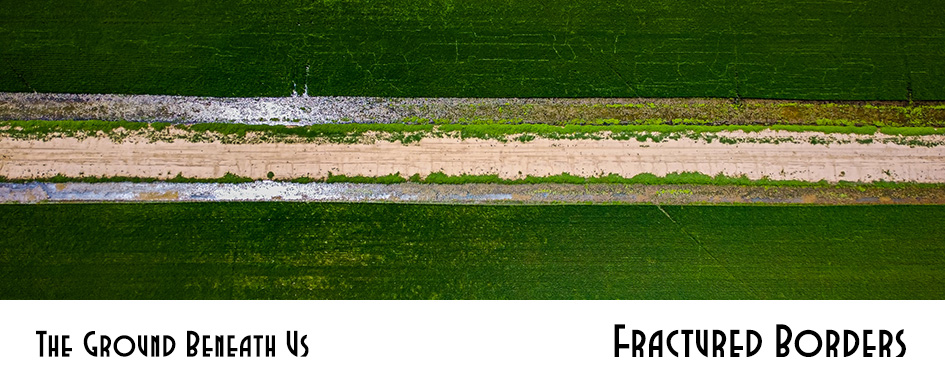
Sitti holds on to Baba’s arm tightly as she leads us off the paved road and into what was once our village. Flowering, uncut threads of golden wheat line the pavement on one side, green prickly pear cacti on the other. They’re a relic of Palestine’s pre-1948 past, when villages demarcated their communities with cacti thorn. Behind the wheat stalks is a mirage of water over plowed dirt patches. Nearby are green fields sporadically lined with trees. Far out into the field, I see a slightly elevated land mass—a small hill that resembles a dome. And then another, followed by another. Enamored by their beauty, I look at Sitti and say, “I thought our land was flat?” She smiles, “no, Alqbab is a truncated pronunciation of al qubab, which means ‘the domes.’”
I walk away from Sitti, take off my shoes, and sink my feet into the ground. Like a child, I dig my toes into the soil, releasing a small dust cloud. The warm soil comforts me, and suddenly I don’t mind the heat too much. The tension I carry dissipates. And in the words of poet Nayyirah Waheed, I suddenly feel “everything [I]’ve ever lost come back to me.” I close my eyes. Open. The field before me is exactly what my imagination remembers. Only more beautiful. So beautiful. I cannot believe such beauty runs through my veins and sculpts my features.
I look towards my family, their shadows growing longer. Still holding Sitti, Baba presses his nose down, nostrils flaring, trying not to cry. Sitti scans the field, points to a corner, and says, “That’s where hayat ‘ammi Abu Sleiman and his family lived.” Sitti then points to the one remaining, abandoned square structure a hundred meters out: “That was the boys’ school. Your grandfather studied there.” She turns around, and steps towards the pavement. “This is the start of our walking route towards Ramleh, where we traded in our crop for jugs of fresh water.”
My cousin moves over to Sitti and hugs her, laughing. “So you were one of those acrobats balancing water jugs on your head?”
Sitti beams. “Yes,” she laughs, “and unlike your generation, we didn’t know laziness.” She sighs, releases herself from my cousin’s embrace, and looks up. “I climbed these trees and picked fruit.” She then points to the prickly pear cacti, “I peeled those thorny cactus fruit with my bare hands. Aah willa?! We didn’t have those thick gloves back then!”
This is Baba’s cue to walk through the beams of the setting sun over to the prickly pear cacti, maneuvering his slim torso around the pointy spikes. His thick, soft hair—inherited from Sitti—falls over his forehead, face glowing in the heat. The cacti blooms with sun rays from its spherical pads: yellow and orange sabr. The meaning of sabr is dual: “cactus fruit” and “patience.” With pre-packed gloves, Baba picks the sabr, honoring my grandfather’s one request of us on this trip: to bring back sabr from Alqbab. Sidi knew the sabr would still be around.
The golden hour is upon us, and the sun retreats, emitting a warm glow from which Sitti’s silhouette emerges. Before it settles, the sun turns the soil—just like Sitti once did—unearthing its red hues. Sitti bends to touch the ground. I watch as the cracks in the soil stretch towards Sitti’s fingers, transforming into the wrinkles on her hands. The buried roots emerge as her green veins. And the deep reds of the earth brighten into the poppy undertones of her dewy skin. I finally know where Sitti got her remarkable color.
Just as Sitti is who she is because of Palestine, the earth, too, is who she is because of Sitti: her tending, her tilling, her love. And just as I inherited Sitti’s memory, I inherited her belonging. I inherited Palestine, who I now know forever lives in the soil as she does in my memory. I want to apologize to Palestine, tell her I should have never doubted that she’s been here all along, not even for a moment. She shushes me with a slight breeze. She understands. Suddenly, the wind gushes to embrace us—all of us. I see now that to Palestine, we too are home.