I’d come to Ilulissat as a detour. I had two spare days between a hike in Iceland and a two-week backpacking trip along Greenland’s east coast. I told the curious travel agent: “I’m interested in ice.” What I meant was, I am interested in what ice holds. What it keeps. What it reveals.
It was August, nights bright with the midnight sun. The boardwalk in Ilulissat winds out to the headland above the Icefjord, past dwarf willows and Arctic cotton grass, past the low hummock in the ground that marks Sermermiut. The site is four thousand years of life compressed into a stain in the earth. Here, it’s possible to read the human history of Greenland from bottom to top. The settlement is one of the largest in the country’s history.
Archeologists know about Sermermiut because of fragments. The site is alternately known as a “kitchen midden.” Midden, meaning rubbish heap. The Sermermiut midden contains domestic items such as pots, tools, arrowheads, art objects, and even dolls. It is a place of food remains, shells, animal bones, ashes, charcoal raked out of cooking fires, and human excrement. The midden doesn’t distinguish between treasure and trash. The midden is democratic. It holds what was left behind.
A museum panel near the site read like a caption for a vanished world: Once Sermermiut was full of life and howling dogs; now the tourist cameras spin.
I barely noticed it, and if not for the signage, I wouldn’t have known what I was looking at. It was a depressed, dark spot in the land. A muddy patch of grass.
But this is the nature of the fragment: it’s present before we know how to look.
Essayist Morgan Meis argues that fragments are clues to how reality works. They reveal more than the whole from which they came. They tell a greater truth about fragility and time. About a perfectly preserved moment.
Now the tourist cameras spin.
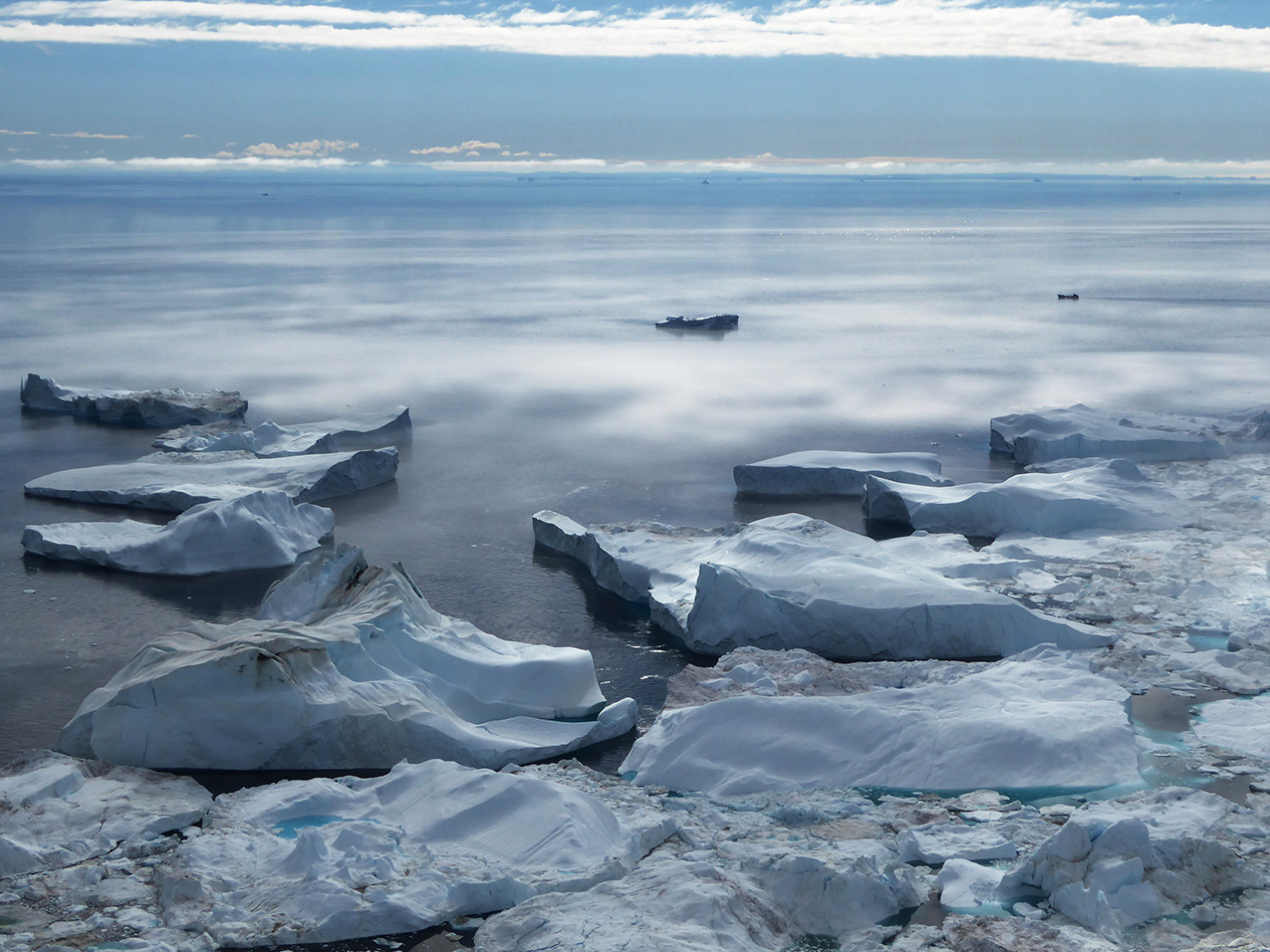
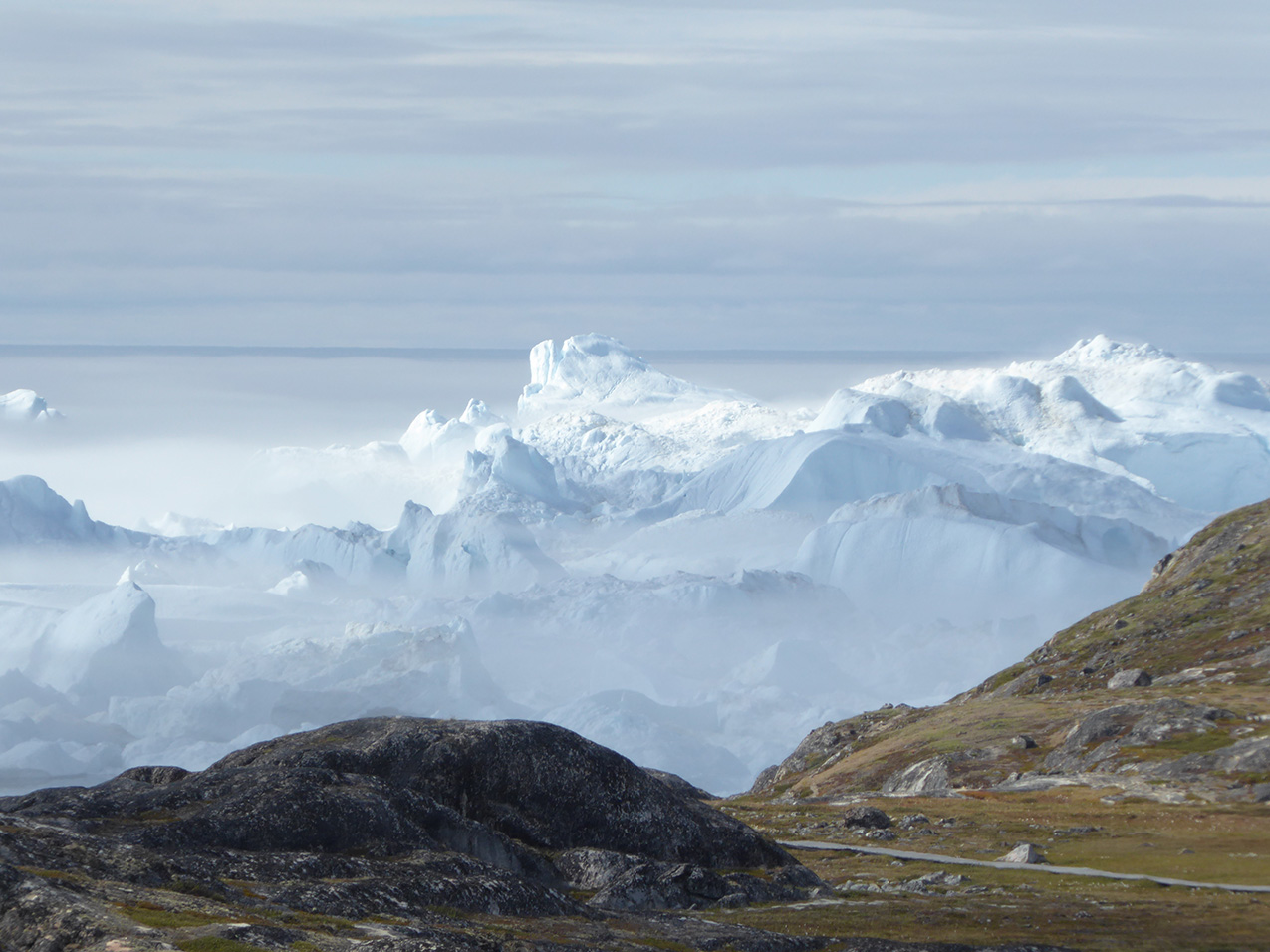
I didn’t notice the midden because I was too stunned by the Kangia Icefjord, a UNESCO World Heritage site, to see anything else. Icebergs rose from the water like the red rock of the Utah Canyonlands, which I’d once floated past on the Green River, watching the walls grow taller as I neared the Colorado. The icebergs seemed as stationary as those canyon walls. But I knew they were moving because there were cracks between them where aqua-green water pooled.
A couple lounged on the big black rock in front of the cracked ice. How small they looked, how intimate. But also how unlikely. My camera wouldn’t quit spinning.
Maggie Nelson, reflecting on the construction of her book Bluets, speaks of the fragment as garbage, refuse—the excessive, the leftover of our lives. What remains after desire has passed through a place.
The midden, it seems to me now, is the original archive of the leftover.
It wasn’t until I went to the Knud Rasmussen Museum the next day that I understood what I’d walked past. The exhibit explained that the midden holds layer after layer of fragments from every culture that has lived in West Greenland.
The first layer recorded Saqqaq people, who arrived around 2500 B.C., their hearths scattered with boiling stones. They didn’t use soapstone lamps. Their heat and light came from open fires. They used dogs for hunting or to carry packs. They didn’t harness them to sledges.
Then a thin layer of peat without any fragments, meaning no people for some time.
The next stratum traced the Dorset people, starting around 800 B.C. No dog bones in their layer. Apparently, the Dorsets pulled their own sledges. They loved chalcedony and agate, where the Saqqaq had favored killiaq, a fine-grained stone quarried from the island of Agissat down the coast.
Then silence: another thin layer of peat with no artifacts. No settlement. People gone.
The poet Edward Hirsch calls the fragment a radiant moment never to be completed because it aspires to be infinite. What, then, is the silence between fragments? The peat layers with nothing in them?
Then the Thule people arrived around 1200 A.D., with their ice knives, harpoon heads, kayaks, umiaqs, and dog sledges. They spread throughout West Greenland, where they met the Norse people who occupied the south. The settlement at Sermermiut continued until 1850.
The museum exhibit was blunt about the fantasy of “the prehistoric, isolated, freezing Inuit.” Inuit, meaning descendants of the Thule. These were people who traveled and traded. Moved iron, copper, wood, soapstone, killiaq, and antler across long distances. Carried knowledge of other peoples, resources, and routes.
The midden holds the evidence. Or held it. The permafrost that has preserved it is thawing. The sea is eating away at the land.
A few years after my first visit to Ilulissat, I had to go back. It was April. Just when the polar night was cracking open.
A young woman of thirty named Nikoline Berthelsen, a native Greenlander, owned and ran a café called the Kangia, named after the famous icefjord. She told me she’d built it from materials rummaged from things others had thrown away. The chairs in her café, some wooden, some upholstered, were mismatched in a stylish way. Some of the shelving, also mismatched. A kind of grandmother’s quilt of pieces made up the place, with a mesmerizing print of a beluga plunging into a blue ocean in the front lobby. All objects that had been thrown away were now the interior of a place where everyone gathered.
An encyclopedia of local knowledge. A midden of the living.
One day in her café, the Elvis song Can’t Help Falling in Love played softly, and through the window, the icebergs loitered in the fjord like white buildings in a city slowly being demolished.
I asked Nikoline if climate change worried her. “Yeah,” she said, shrugging. “It also inspires me.” She said she’d seen a video of a small village in Japan that was zero-waste. It inspired her to go further in her use of fragments, garbage, and reuse. She started giving the café’s food scraps to the sled dogs. She recycled plastic and paper.
Then she said something I’ve thought about ever since: “The world is like an aquarium. When a volcano erupts in Thailand or Hawaii, the ash falls on the inland ice, and from there it flows to the icefjord, and from there to the sea. Everything happening on the ice is happening to the whole world. The ice is a memory of everything.”
The fragment, too, is a kind of memory. The trace. The ash. The residue. The dark stain where something used to be.
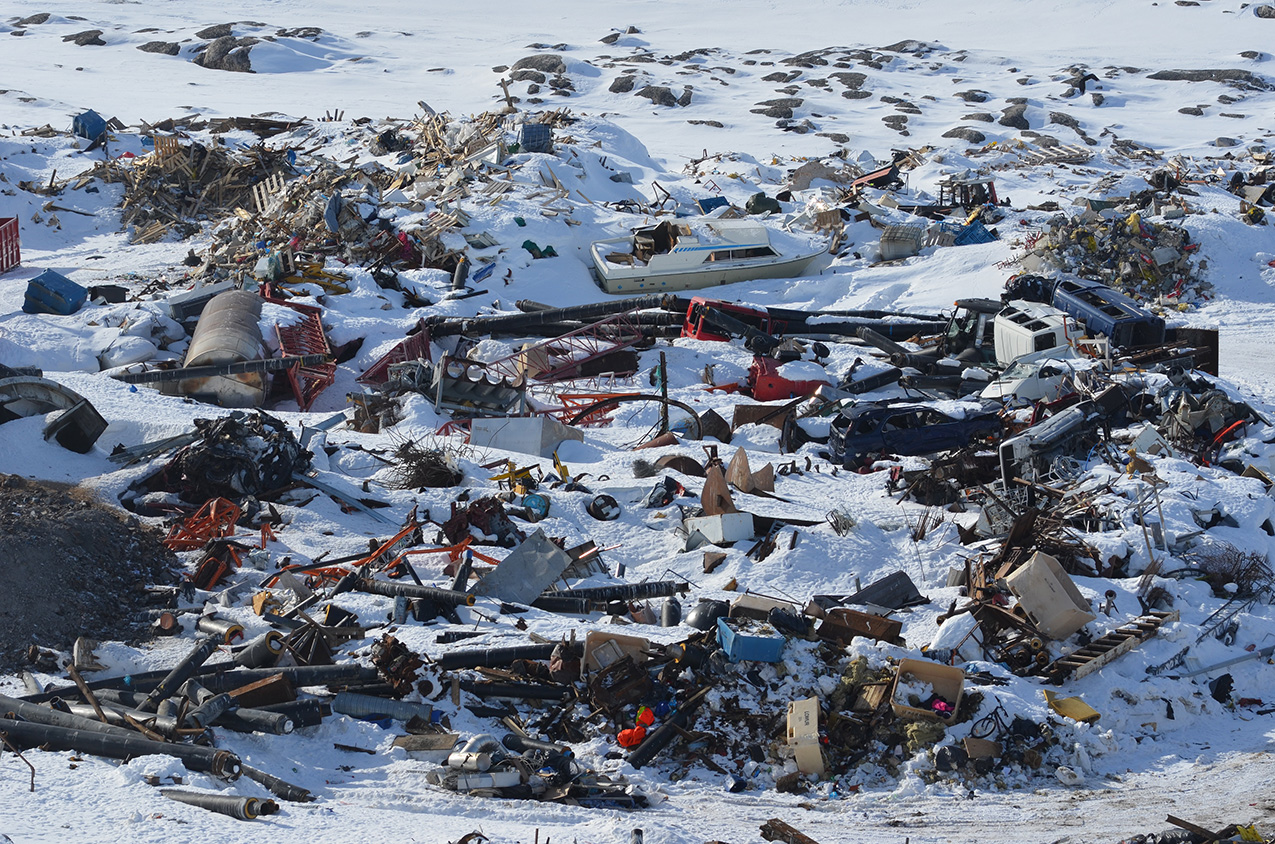
Sitting a couple of kilometers from the Knud Rasmussen Museum and Nikoline’s café is the present-day Ilulissat rubbish dump. It has become something of an international celebrity, if you can use that term for a piece of ground. Photographs of it circulate online. A tangled, colorful heap in the foreground, white iceberg towers behind. People have captioned the photos “Garbage Bergs.” Or simply titled them, “Climate Change in Greenland.” Ilulissat’s postmodern midden has become a meme.
One day after I’d sat in Nikoline’s café all morning, I made the half-hour walk to the rubbish dump in an icy wind. It smelled like nothing. Like fresh air, so different from the waste management facilities of my native Washington State. But the refuse was different. I saw complete motorboats, including a big motor yacht that might have belonged to some zillionaire, grounded on the ice. Crates and pallets, broken dog sledges. Metal parts, heaps of yellow foam—the innards of furniture—piles of lumber, full-sized shipping containers, nets and ropes, and twists of derelict plastic twine from the fishing industry. A single paper coffee cup.
I was stunned by the largeness of many objects, as if they were trying to compete with the icebergs themselves. And my tourist camera spun.
It struck me that every object in that heap had been wanted once. Every scrap of plastic and metal purchased, carried, used, and discarded: the same arc of desire and abandonment that lay in the ancient midden. Only faster. And in materials the earth can’t hold.
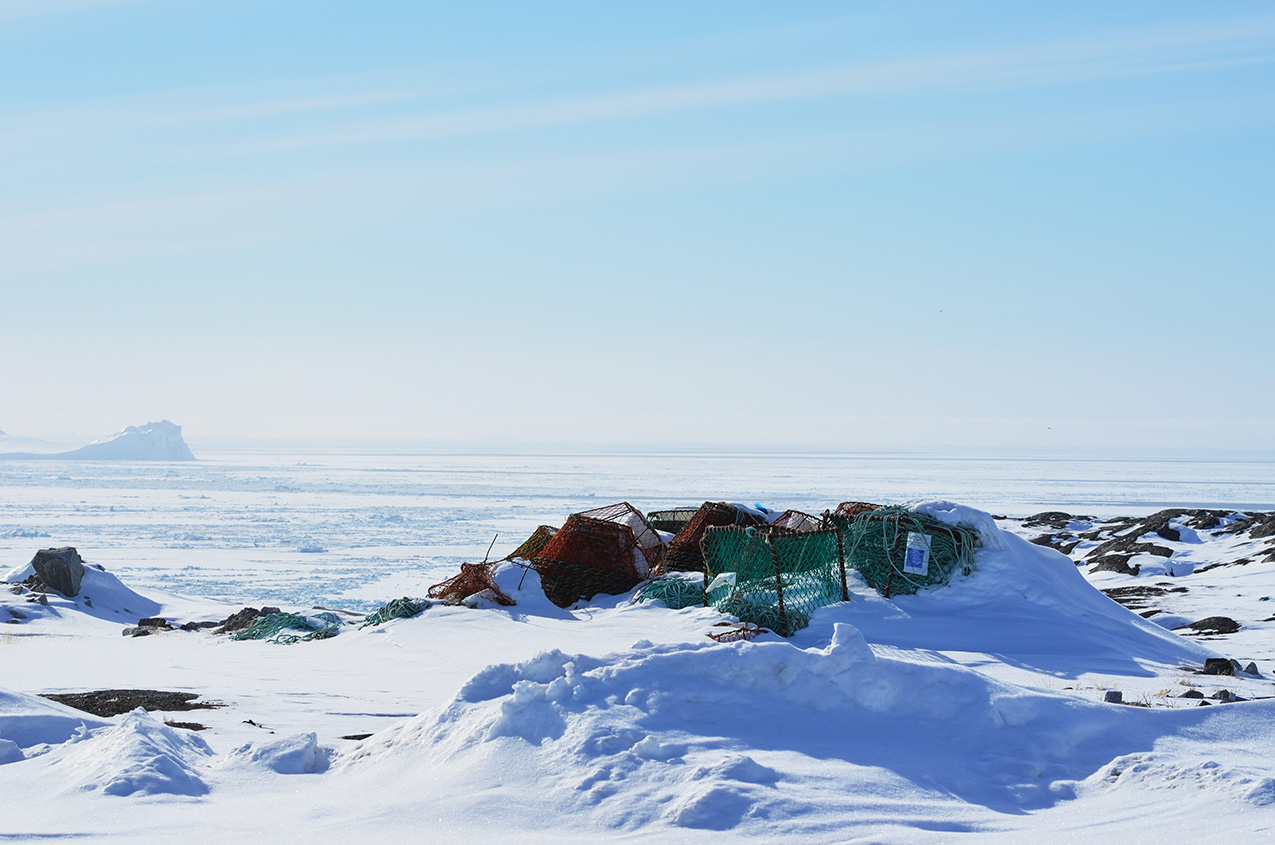
The midden at Sermermiut was a darkness in the soil. This one was a brightness: vivid, gaudy, photogenic.
Some say the broken thing is more beautiful for being broken. The fragment is more itself, more true, because something has been lost and the loss is visible. I can’t argue with this.
Nelson writes of admiring Joseph Cornell, who collected large quantities of trash and junk all over New York City, then carefully curated the pieces into memory boxes. Each box distilled something exact. “The composition emanates from the piles of junk left in its wake,” Nelson says, “but it in itself becomes perfect.”
Nikoline’s café was the Cornell box of Ilulissat.
Only after I left the dump did I see the sign, printed on weathered wood: Items collected at Ilulissat Municipality’s waste facilities are the property of Ilulissat Municipality. Collecting usable items from the dump is prohibited. I don’t know if Nikoline collected some of her décor from this place. But I wanted to imagine she had.
Archaeologists estimate that within 80 to 100 years, the fragments at Sermermiut will disintegrate entirely. Our warming world is a product of another great accumulation, a midden of carbon we’ve been building since the Industrial Revolution.
The radiant moment darkens. From larder to meme: this is the arc we’re living through.
A few days after my visit to the rubbish dump, I went up in a small plane with a Danish pilot named Ricky, who wore a gray jumpsuit like a space explorer. From the sky, the Kangia looked like hope and sorrow modifying one another.
We descended to five hundred feet, then lower, and slid between two icebergs, one four hundred feet on our left, one five hundred on our right. We were face to face with these silent beings. One of them looked me in the eye, and winked.
The ice at the glacier’s face was rough and spiky. The inland ice behind it, smooth. Ricky pointed to a strip of brown-gray along the edge of the ice sheet. “That’s the mud left behind by the retreating,” he said. It looked like something horrible revealed. “It has pulled back fifty meters since February. What used to take one hundred years now happens in ten.”
“I have enough photographs of icebergs,” I wrote in my field notes. Still, I took more.
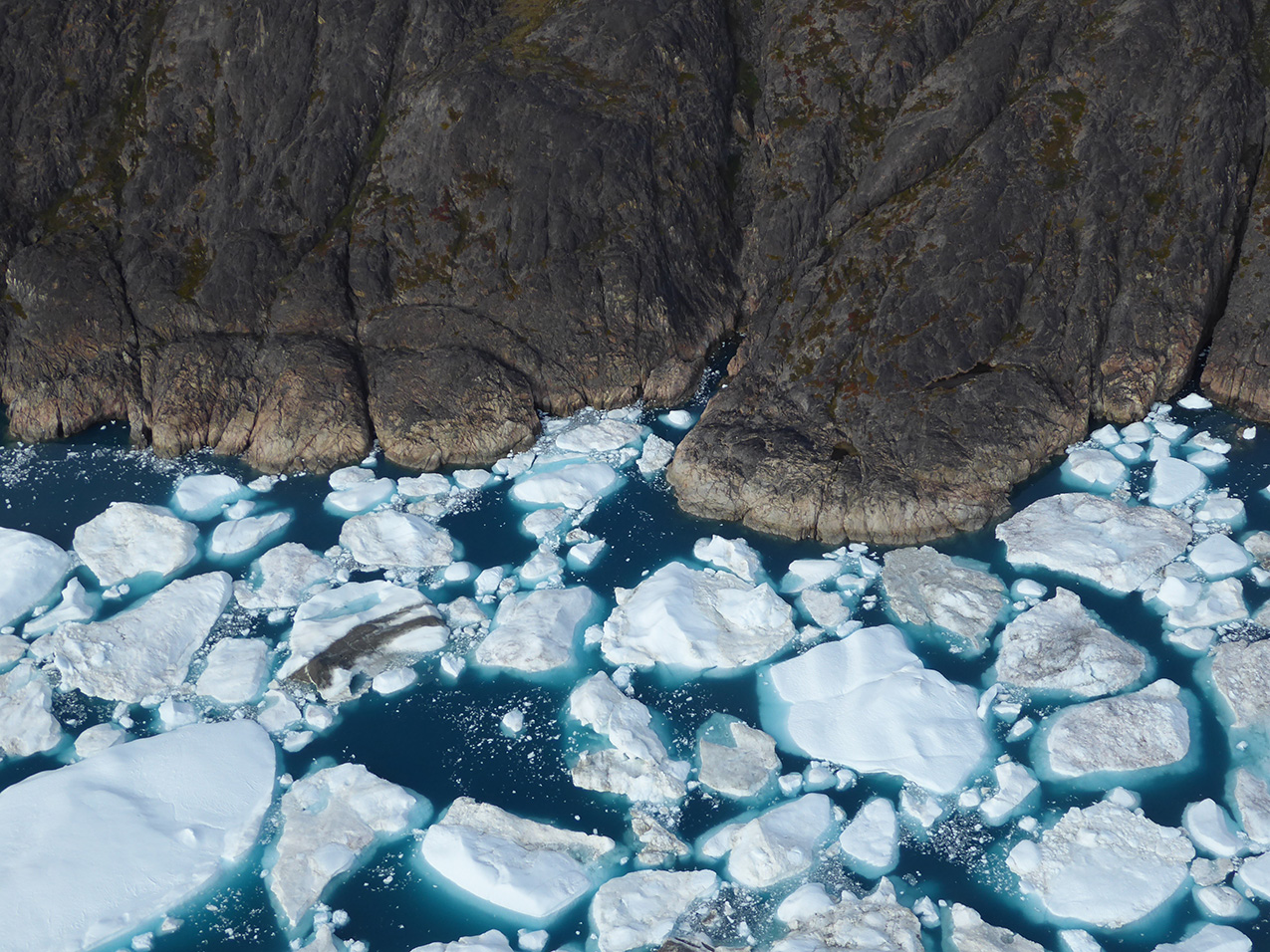
Part of the Sermeq Kujalleq, the Greenlandic name for the glacier that fills the Kangia, is now calving over land rather than water because the glacier has withdrawn so far inland. To look at it now, a German woman named Diana had remarked to me in the café, is like knowing the Sistine Chapel will vanish. The pilot, Ricky, called it “the dead glacier.”
Nelson says that writing a book of fragments carries a certain pain: “the pain of manifestation.” Every decision you make defines a work that was previously a beautifully diffuse mental cloud. The fragment form preserves something of that cloud. It refuses total resolution. Maybe that is why I kept returning to Ilulissat, to hold this world a little longer, in pieces, in the cold.
Today, the idea that Greenland is being treated like a neat real estate deal by the US frightens me.
Nikoline has since sold the café. I don’t know if it has been reenvisioned or dismantled, but I imagine some of the interior design material has gone back to rubbish dump as fragments, someone else’s treasure now.
On my last evening in Ilulissat, I walked the boardwalk again. I’d been grateful for this route to the ice. But today I think of it differently. I realize the boardwalk has a goal: to put you on a path that leads you to the edge and tells you where to stand. There’s intention in that. The same intention, taken to an extreme, that proposes to purchase an island or even take it by force.
I stood at the promontory and let the icebergs stop my mind. They were cracking. Pieces falling into the sea.