Days before my mother died in September 1989, her hand was trained to the dial of a short-wave radio, listening to Radio Free Europe and to reports of Solidarnosc, as Lech Walesa’s trade union paved the way to partially free elections, the first since 1945. Marched out of Warsaw in October 1944 as a prisoner-of-war, my mother never returned to Poland. Whether by design or circumstance, life took her farther and farther from her homeland. Over her lifetime, she was to live in eleven countries and on four continents. In each country, she would search for the world she had lost.
During the spring of 2019, I visited all the neighborhoods in Warsaw and Kalisz where my mother had lived. It was my fourth trip to Poland to research her past, one that remained shrouded in secrecy during her life. Growing up, my mother never spoke about Poland. It was a country that had almost disappeared from the map. Poland was a ghost-scape, a country best remembered, she said, in the 14th century during the reign of King Kazimir the Great.
As I walked through the neighborhoods of these cities, taking in the facades of buildings, examining their height and scale, I understood that each structure represented something of my mother’s history, some indelible part of her life story, and that in searching for the many buildings where she had lived, I was seeking concrete evidence of her past.
Over the last months, I have found myself revisiting my trip. I have been thinking less about discovery and more about safety. As the world around me fractures into violence and chaos, I have been thinking about the deepest connection to place and the meaning of home. As my children have now made their way in the world, and my husband has taken a job in another city, I have clung to the shelter of my own house, even as I remain stubbornly alone. Looking out from the window of my study, stationed somewhere between the shelves of my books, I have been thinking about my mother’s inability to shelter, no matter how many times she moved. I have been thinking about how her search for a safe house became mine.
My mother was 15 years old when the Germans occupied Poland in 1939. Her high school records reveal a girl deeply interested in astronomy and theater. She had long reddish hair. She was called carrot top, rudzilelec, she once told me. Before she turned 17, she was a solider in the Armia Krajowa (AK), Poland’s Home Army, the largest underground resistance movement in Europe fighting against the Nazis. By the time the Warsaw Uprising began in August 1944, she was already a veteran soldier, schooled in the arts of conspiracy. A few weeks later, now 19, she was promoted to Sergeant Major. On September 25, 1944, she was awarded the Virtuti Militari, Poland’s highest medal for courage.
During the last year of the war, my mother moved often. Separated from her family and held to strict secrecy about her roles in the Resistance, she went from one apartment building to another, one safe house to another. Each move was fraught with danger. Each relocation was only safe if it was secret. She lived by the code of the Armia Krajowa. Survival depended on the ability to adhere to the rules, embodied in these three lines:
Never ask anything. Never tell anything.
Always have a story ready.
If a contact is caught, be ready to move somewhere else.
Sometimes the addresses aligned with the Warsaw neighborhoods where Krybar, her military unit, was fighting and sometimes not. A brick building on Franciskanska Street, listed as her ‘last’ address, was located inside the walls of the Warsaw ghetto until late 1942, when the boundary was changed. Another building on Towarowa Street, the first Warsaw apartment my mother lived in, miraculously survived the bombing when most of its inhabitants did not.
The eldest of three children, my mother, Maria Leonarda Przytula, was born in the city of Kalisz, in south-west Poland. For the first seven years of her life, she grew up at No. 11 Cmentarna Street, a peaceful, tree-covered street next to the city cemetery. A heron-grey wall separated the houses from the cemetery, so low that a child could easily scale it. The tops of the gravestones and monuments were visible from the street and the branches from the trees that grew alongside the graves spread shade across both the living and the dead.
My mother’s father, Franciszek, whom I never met, was a soldier in the 29th Rifle regiment of Kaniow. A photograph from his military records revealed a handsome, dark-eyed soldier with a cleft-chin. By the age of 16, Franciszek was enlisted in the Polish Army. Forging his papers to appear two years older, he fought in WWI, the Battle of Warsaw, and later, in the September Campaign of 1939 and WWII. A long and impressive list of his military awards includes not just one but two Virtuti Militari, a Cross of Valor, and a Croix de Guerre for his activities in occupied France.
In family notes, handwritten by a cousin and drawn from conversations with her mother, Franciszek’s marriage to my grandmother Eugenia was described as a ‘mesalliance,’ a marriage of convenience. The same notes remark that Eugenia had been in love with a Polish soldier killed during the Great War. In the only photograph of my grandmother that remains, she appears stern and self-contained. Convent-educated with beautiful copperplate handwriting and fine embroidery skills, she was fiercely independent, working daily as an office clerk to help support her children.
My grandfather was 20 when he married my grandmother and 23 when my mother was born. His youth and my grandmother’s prior relationship may account for the repeated descriptions of my grandfather as a ‘Ladies Man,’ the kind who returned from his weekend forays bearing gifts of jewelry to assuage his disconsolate wife.
The records I collected from my trip to the City Registry in Kalisz reveal that over the fifteen years that my mother lived in Kalisz, her family moved six times. On September 3, 1939, two days after the German invasion of Poland, my grandfather’s regiment left for the front. One day later, on September 4, the German army invaded Kalisz. The city was instantly declared Reichsgau Wartheland, land annexed and part of greater Germany. The policy of Germanization implemented in Kalisz forbade the use of the Polish language and the expression of Polish cultural traditions. Street names were changed. Schools above the elementary level were liquidated. The teaching of history was forbidden. I found my mother’s signature recorded on a document from the stately Anna Jagiellonka High School, in Kalisz, withdrawing her school records. Dated September 9, 1939, it was the last ‘official’ schooling in Poland that my mother received.
On October 12, 1939, the Przytula family suddenly left the single-family brick house (their first and only) at No. 12 Mickiewicza Street and moved to a building with “multiple dwellings” further down the same road. More than likely, this single-family house was taken by the German army for their officers.
How often I have wondered what she thought the day she left, with only moments to pack her belongings. Were there half-eaten meals and unmade beds left behind? Did she kiss the four walls as I do, begging forgiveness for leaving and securing my return?
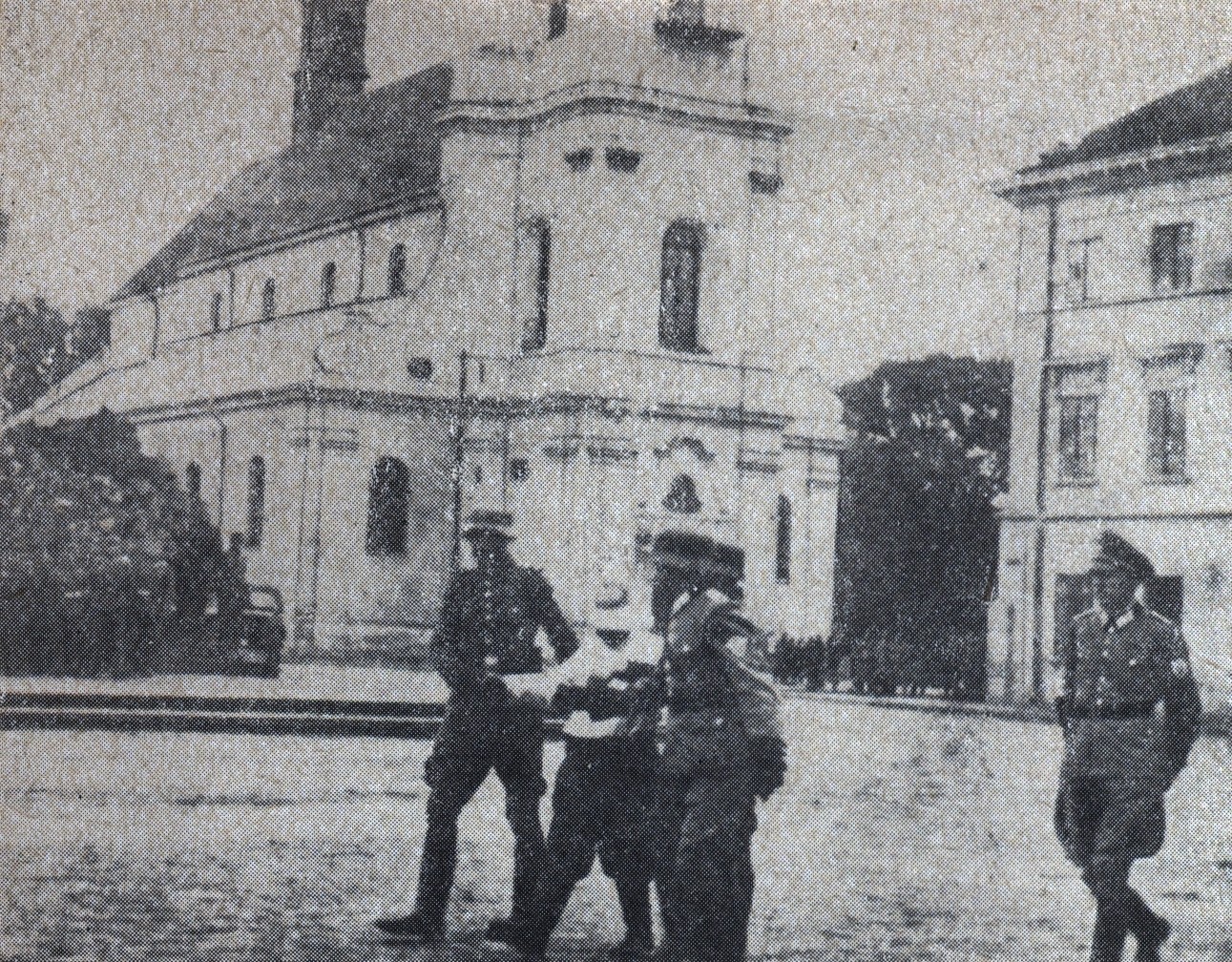
It was sometime over the next month, that my mother, grandmother, great grandmother, and my mother’s two siblings fled from Kalisz to Warsaw. No longer safe, they were among the hundreds of thousands throughout Poland leaving their homes. My grandmother carried the jewelry she had been given as recompense, sewing each piece into the folds of her children’s clothes. It was this jewelry that she later used as payment and bribes to secure passage for her family.
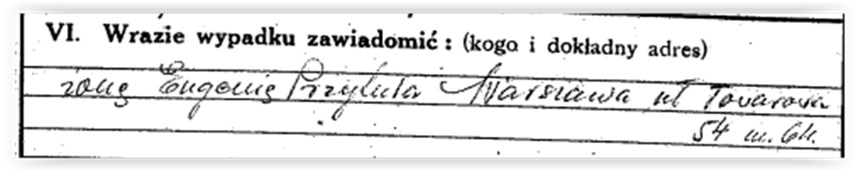
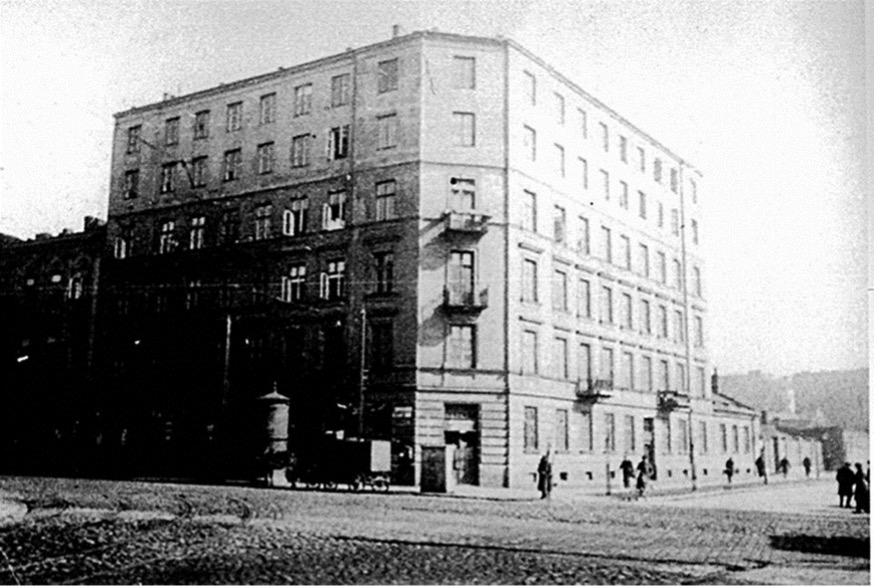
In Warsaw, the family stayed in an apartment owned by an ‘Uncle,’ presumably a member of my grandfather’s extended family. 54 Towarowa Street, Apartment 64, is listed on several places in my grandfather’s military records. The 6-story building was located in Wola, Warsaw’s industrial district, an area packed with factories, tenement houses and the loud noise of cable cars plowing up and down the avenue.
In August 2014, Warsaw blogger Jerzy Majewski featured 54 Towarowa Street in an article that was published in the Polish newspaper Gazeta Wyborcza. The piece was devoted to the history of the building and to its eclectic mix of pre-war inhabitants. Among those profiled was a man from Japan named Ryochi Umeda, the first ever professor of Japanese language at the University of Warsaw. Although Umeda left Warsaw in 1939 when war was declared, he had fallen in love with Poland and, years later, on his death bed, he made his son promise to return to his “adopted home.” Through his deep interest in Polish literature, Umeda was connected to the poet Konstanty Ildefons Gałczyński, who also lived at 54 Towarowa Street. Somehow, Umeda helped to facilitate an empty apartment in the building for Gałczyński to use as a poet’s den and it was at 54 Towarowa Street where many poets of the day would gather to read and discuss their work.
Towards the middle of his blog, Majewski includes an eyewitness account by a Mrs. M, whose parents owned an apartment on the first floor. “During the first days of the Uprising…the streets were defended by the insurgents, under the command of Captain Hal. The gate was barricaded and the residents hid in the basement. However, on August 5 [1944], the Germans broke in, taking over the intersection between Towarowa and Chłodna. The houses were smoking and the civilians were shot.”
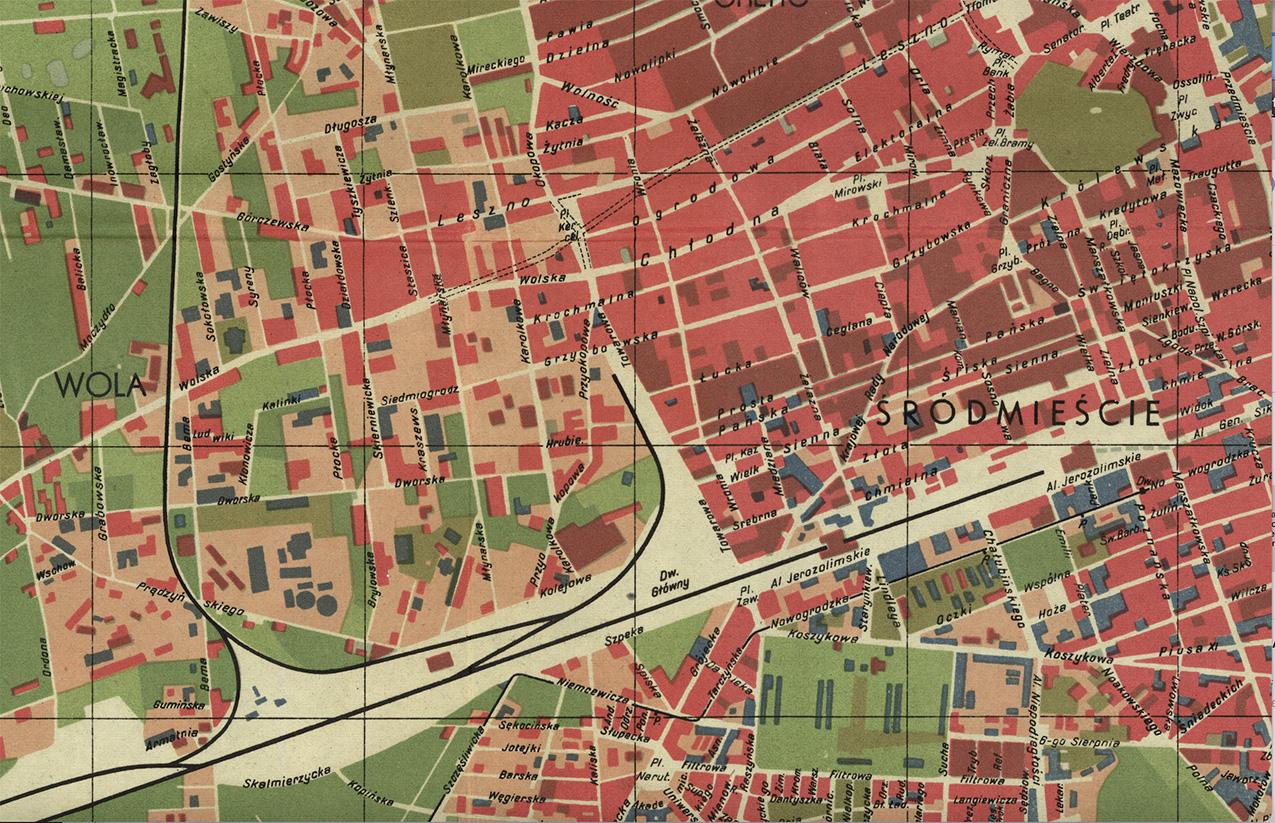
Determined to quell the Polish “Banditen” and stop the Warsaw Uprising, the orders from Hitler’s SS commanders were that every inhabitant of Wola must be killed. Over a one-week period, between August 4–12, approximately 70–90,000 civilians, regardless of age or sex, were systematically massacred as the neighborhood of Wola and her inhabitants were burned to the ground. Although I have no records to determine her location over those exact days, it was my half-brother, born just after the war, who recounted the story my mother told him of holding my grandmother in her arms, fatally burned.
*
Several months before my trip, I was sitting with my colleague and translator, Katarzyna (Kasia) Timmer Lubaczewska, in a café near my house in Washington, D.C. It was the same café where we had met several years earlier, brought together by her documentary film, “Scouts Forever,” which profiles a group of Polish Scouts, whose eighty-plus-year friendships stretch from childhood through the war to the present day. At the small café table, Kasia showed me a Powerpoint she had been working on in anticipation of our trip. Each slide featured detailed maps of Warsaw with the combat routes of my mother’s unit through the neighborhood of Powisle outlined in red. Kasia had starred the points of entry to the sewers, where my mother would have carried messages between neighborhoods and through the labyrinthine passageways underneath the city where Polish soldiers were able to circumvent Nazi strongholds. She also pointed out many of the spaces and buildings where my mother would have stayed during the Uprising. She marked the hidden interior courtyards of apartment blocks, the small makeshift shelters in between the buildings, the alcoves where soldiers and combat nurses would rest, sleep, smoke, recover, eat, make love, before moving on again. Soldiers who were my children’s age, teenagers and early 20s. Spaces where an illusion of safety prevailed.
Kasia also included the convents where my mother could have stayed during the early years of the occupation. One of the convents, The Franciscan Sisters of the Family of Mary, was located at the at the corner of Franciszkańska and Leszno Street, where the Warsaw Ghetto had one of its gates. Over the years, my mother intimated that she had spent time in a convent, obliquely referring to the “paper shoes” she had once worn and how her fine embroidery skills were a gift from the nuns.
Following Kasia’s lead, I walked the streets of Warsaw for hours. We stopped underneath placards dedicated to the Krybar soldiers for their heroism and sacrifices. We passed endless monuments and sculptures to the Uprising, some now gradually obscured by a surge of new office buildings, and stood for photographs near a manhole where my mother would have entered the sewers. We rested inside empty courtyards, standing against walls with bullet holes still preserved. We peered into the field hospital on Konopczyńskiego Street, now a museum with a stage set of an operating room, a place my mother would have taken wounded soldiers or gone to get medical supplies. We circled the convent at the corner of Leszno Street, the rain pelting down, staring through the bars of an iron fence to a silent building whose garrets and alcoves and cellar still held untold secrets.
Umbrella in hand, my face chafing from the cold, I mourned a mother I did not know. Rudzilelec, I whispered.
It was on our last day in Warsaw that we visited the neighborhood of Wola and the building at 54 Towarowa Street. It was raining again. Steady sheets of rain, creating a mist that made it difficult to see. I knew from Kasia’s slides that the building on Towarowa Street, although largely burned during the war, had survived, even if semi-intact. The black and white photographs showed the building’s blackened façade. Somewhere in Majewski‘s blog, he described that, after the war, when all the buildings were surveyed by the city’s building engineers, 54 Towarowa Street was slated to be rebuilt and modernized. Eventually, it was.
As we approached the mass of new building, I could feel my eyes searching for the 6th floor. At the corner of the street, there was a large rock with a memorial inscription to the poet Gałczyński. I stood there for a long time. The site represented something I could not put into words. All the war was concentrated in that apartment on the 6th floor of 54 Towarowa Street.
I tried to picture the building’s interior, its high vaulted ceilings and narrow hallways. The door was open and I imagined my mother, young and almost unrecognizably thin. She was alone and the room was sparsely furnished, the walls covered in a wallpaper that was faded, once a rich brocade. I pictured her standing near the window as I searched the apartment for clues. I thought of her uncanny ability to construct a temporary home from a few cushions and a blanket. She had always taught me how little was needed, how quickly one could adapt. Wherever we lived, she could transform the space into one of belonging, however fleeting. Towels or sheets became walls; cardboard boxes magically became a chest of drawers. Empty bottles filled with branches or flowers from nearby trees. Here, she would say, pointing to the welcome nest she had made, and I wondered whether every successive home she created was an homage to the one she had lost.
It was then, standing there, that I remembered the very particular way my mother prepared me when I traveled alone between a boarding school in England and my family’s (then) home in Romania. I was twelve. I recalled the elaborate letters of introduction that my mother wrote for the places I would stay en route, letters carefully taped inside the suitcases, the suitcases tagged with ribbons. Inside the cases were selected gifts she had procured and individually wrapped and then carefully placed in the deepest softest folds where they would remain hidden until ready to be unearthed. Presents I came to think of as a gentle bribe, an exchange, a way to secure safe passage. I remembered the careful instructions I was given, as if at any point in time, circumstances could shift and change. I would then move to another family, to other friends or acquaintances. There were additional letters written and kept sealed that I carried in my purse for any such change of plan. I remember the steely look in my mother’s eyes, the silent conveyance of purpose. Without words, she had taught me the scent of danger.
I think back to the jewelry my grandmother sewed into the clothes of her children, hidden, kept in the darkness of fabric until they were needed. Perhaps it was through this ongoing ritual, doing what my mother and grandmother had done before her, that I came to understand the fear that accompanied each move, the never-ending search for safety, as if my mother were forever mapping the war.
It is hard to imagine that my mother would not have returned to Poland if she had lived. The timing of her death in September of 1989, just as Poland was emerging from over forty years of Soviet occupation, is hard to fathom.
Would her search for a safe house have come to an end?
Like my mother, I too have lived on four continents. I, too, have searched half a lifetime for what my mother lost, for the story of a girl with reddish hair, rudzilelec, who loved astronomy and theater, for a Poland that existed only in memory. The difference is that for the last sixteen years I have stayed in one house, remained under one roof, fortifying the walls, filling them with life, until I willed my own safe house into existence.