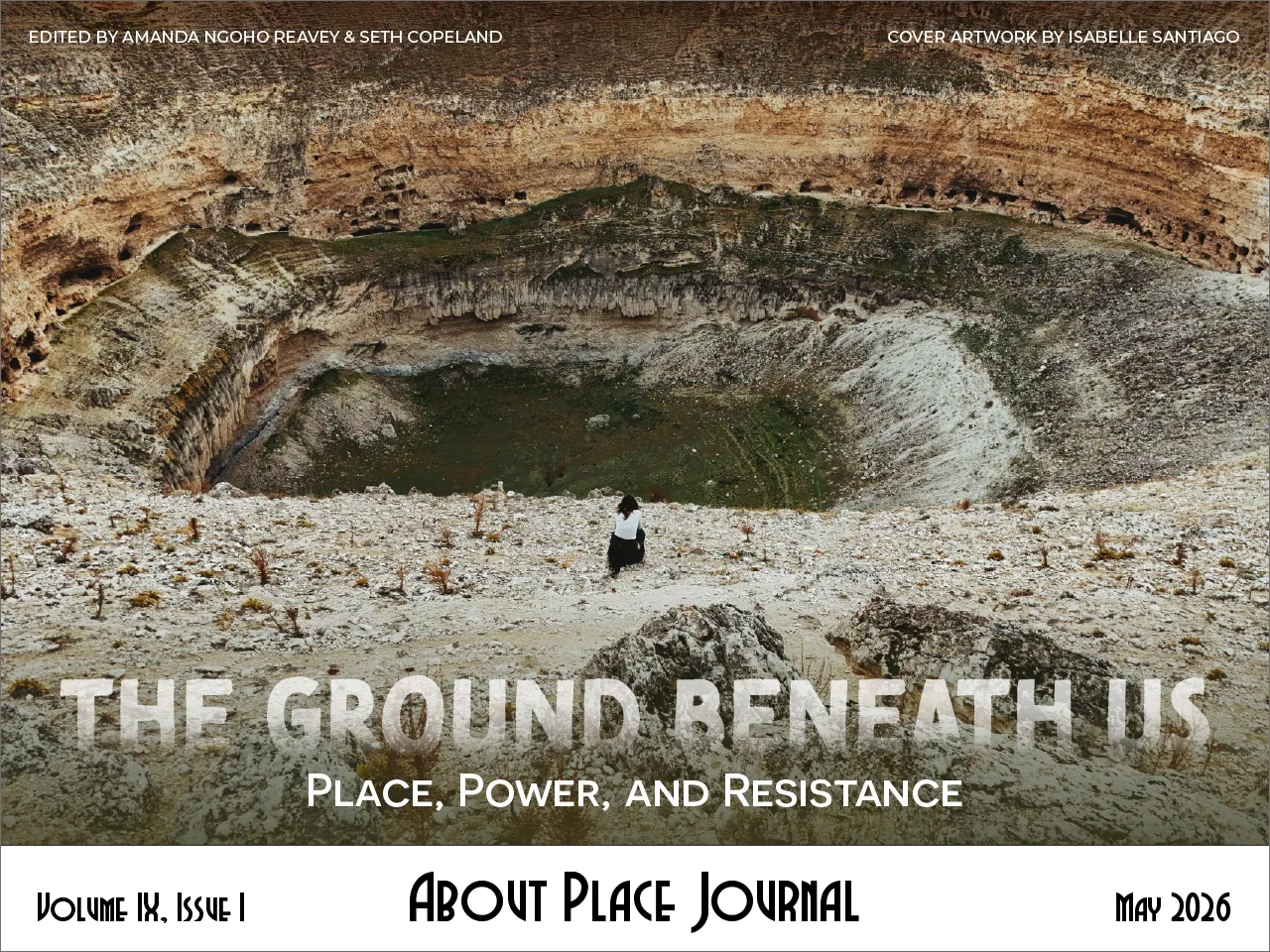
Place “is shaped by [its own] power, [not] haunted, [but enspirited] by memory, and pulsing [not so much] with resistance,” but with voice, calling upon humans to realize that everywhere they walk is sacred and must be protected with infinite tenderness and a heightened reciprocity. Where would humans be without the ground beneath us?
1.
“Coyote says, Humans, Stop Breaking the World.”
Michael Horse, Yaqui/Swedish, artist, actor[1]
With direct biting humor, Michael Horse creates t-shirts and stickers with messages from Coyote, a central trickster / cultural figure / teacher to so many Native Nations. “Coyote says: Clean Up Your Mess, Humans!” Any Indigenous person understands the messages immediately, while non-Indians might likely wonder. In texting language: IYKYK.
I have long noticed that when Native people are gathered, especially outdoors, often around a campfire, there is a silence that speaks with eloquence. It is as if all hearts are connected in a network of spirit that is ancient. In Niimiipuutimtki, the word for “heart” is timíne, which also means “the center of the tree,” and “seed.” It is a word I love because in the one term, the human heart is shown to be in relation to the heart of the earth (through the center of the tree), and to the continuance of the earth and the Niimiipuu people (through the seed).
In those moments of shared silence, sometimes two or more individuals might suddenly nod in affirmation. Or smile. It is the eloquence of spirit. At those times it is natural to remember who we are as human beings, and who we are is always connected to the earth, because NDN peoples come from very specific places, and their creation stories are manifested in these places. In that silence there is a keen awareness of our individual and collective autonomy.
The distinguished Māori scholar, Linda Tuhiwai Smith writes, “For Māori, acknowledging the land is one of the most important and respectful ways to greet others and is far more important than announcing one’s individual name as an opening greeting. Your name is not as important as the name of your lands, mountains, waterways, and iwi. Where we are from, who we are from, comes first in any introduction.”[2]
One of her key points is that Indigenous peoples, for a very long time, some might say since the beginning of time, have practiced land pedagogies that include the concept of land acknowledgement. The Earth comes first. Always.
Circling back to that campfire and the network of spirit, we can imagine what might be going through the hearts of the connected spirits in that silence as they contemplate the black rain that is currently falling in Iran, inflicted by a U.S. gone mad, destroying a land and it peoples, human and more-than-human. Perpetrating yet again another atrocity of trauma at the level of the unspeakable on generations of human and earth peoples. Who will answer for these crimes?
This network of spirit is not only human. It includes all of life. The Earth has her own terrestrial/cosmic telecommunications. The trees talk to each other, the waters talk to each other, the winds talk to each other. The Sun speaks. The Moon speaks. The Stars speak. The birds, insects, fish, four-legged, snakes, talk to each other. And they all speak to us humans. Native peoples who are following their original instructions know that we can and should talk to our earth relatives. We must demonstrate to them that we see them for who they are, that we respect them and love them.
Anishinaabe scholar Lawrence Gross has said that we live in a “peopled universe,” meaning all the more-than-human relations who are peoples unto themselves.[3] The Salmon Nation. The Buffalo Nation. The Caribou Nation. And so on. Humans have a responsibility to listen, to pay attention to these messengers who are speaking to us from the Earth and from the universe.
Humans are not the only ones with intelligence. How ironic. We are witnessing/living a demise of human intelligence during these apocalyptic times. That’s why “Coyote says: Humans, Stop Breaking the World.”
The Earth is not dumb, nor are all our more-than-human relations. Indigenous peoples used to say “other-than” human. The First Nations peoples of Canada began to use the term “more-than-human” some time ago, and it is gaining currency. To not “other” the Earth and all our Earth relations, because we know what that feels like—we’ve lived it. It is much better to recognize what our teachings tell us about our relatives who were here before us (as many of our traditional stories attest). They know this Earth much more than we do. It was their home first, and in our belief-systems, when we are at our best, we know how to live on this Earth, because we understood and still understand them to be our teachers and our guides.
2.
“The Bible’s first creation story in Genesis, chapter one declares that God creates ‘mankind in our image, in our likeness, so that they may rule over the fish in the sea and the birds in the sky, over the livestock and all the wild animals, and over all the creatures that move along the ground.’”[4]
Sally Roesch Wagner, feminist scholar
Humans are only a part of the family of earth. Why would humans ever assume their supremacy over all the more-than-human relations with whom we share the planet? Why would we ever presume the right to abuse the members of our collective family? Why would we engage in such domestic terrestrial violence in the home that we all share? Why would anyone willfully inflict terror on the very earth that gives us life?
Roesch Wagner points out the “they” in the above passage, and how “they” gets transmuted over time to “man,” out of whom eventually woman is created, altering the original narrative, and thus setting up a relentless supremacy of men that persists.
The parallels are so frighteningly obvious to me. The casual, intentional, hideous aggression against women and girls, seemingly an anointed right of men in a heteropatriarchal society, is fueled by the cruelly twisted ideology of male domination and supremacy that has been directed against the Earth and all the peoples, human and more-than-human, who live on this planet. Women are a special target.
On March 8, 2026, for International Women’s Day, the following post, written by Carlos Ernesto Choc, was re-posted on Facebook by Miguel Angel Oxlaj Cúmez, Maya Kaqchikel poet:
#8DeMarzo La realidad de las mujeres en los territorios de Iximulew.
[#March 8 The reality of women in the territories of Iximulew.][5]
Las que no están en las marchas y las que no son visibles en redes sociales, que luchan por sus derechos y defienden la Madre Tierra, guardianas de un legado ancestral, su aporte es muy importante para su comunidad y la sociedad.
[The ones who are not in the marches and are not visible on social media, who struggle for their rights and defend the Mother Earth, guardians of an ancestral legacy, their contribution is very important for their community and for society.]
En este Día Internacional de la Mujer, reconocemos la lucha histórica de todas las mujeres en los diversos territorios de Iximulew—Guatemala. A pesar del despojo, el racismo de un Estado patriarcal siguen resistiendo y alzando la voz.
[On this Women’s International Day, we recognize the historic struggle of all the women in the diverse territories of Iximulew—Guatemala. Despite the dispossession, the racism of a patriarchal State, they continue resisting and raising their voices.]
No más desalojos y criminalización en contra de las mujeres Maya Q’eqchi’. Libertad para las mujeres de Semuy II, El Estor, Izabal, quienes fueron condenadas a 75 años de prisión, en marzo 2022, por defender su territorio ante la invasión del monocultivo de palma aceitera. Cuando el Estado deje de reprimirlas podremos hablar de reivindicación.
[No more removals and criminalization against Maya Q’eqchi’ women. Freedom for the women of Semuy II, El Estor, Izabal, who were sentenced to 75 years in prison, in March 2022, for defending their territory from the invasion of the monoculture of palm oil. When the State ceases to repress them, we can talk about revindication.]
The post is accompanied by two photos, the first of Mayan community women, holding long sticks, standing in their fields, in an organized line (of defense), and one young man with them. The second photo is of police looking at the women in an intimidating manner, one with a smirk on his face, while a Mayan community woman looks away from them.
This is only one instance in a long history of Indigenous women acting as fierce defenders of the Earth, often risking and sacrificing their lives.[6] They know the Earth, they know how she wants to be treated and that she, and they, represent the Female Principle of Life, a principle that is generous and inclusive of difference.
Roesch Wagner writes,
To Indigenous people, woman has always been the sacred creator of life who also, as the agriculturalist, was the creator of life from the soil. She was deposed from this revered status as Earth lost its creative power in Genesis and woman became the source of evil. Earth was magically disempowered in the patriarchal mind from an active agent, the creator of life, to a passive receptacle into which men placed their seed. Woman’s image followed. Her vibrant, God-like creative powers followed Earth into submission; her body simply became a receptacle for men’s seed. Just as woman had been exalted by her creative connection to Earth in pre-Christian times, man, who was now the creator of the seed of life, recreated God in his image. The Earth Mother was deposed by the Sky Father. The circle of relational life was sacrificed upon the hierarchical, linear cross of Christianity.
Indigenous women have been working towards rematriation. As Crystal Cavalier-Keck, Occaneechi Band of the Saponi Nation, notes, “[R]ematriation centers Indigenous women, matrilineal knowledge systems, and cultural continuity to heal what was disrupted, displaced, or violently stolen . . . [R]ematriation is a spiritual and political act of reconnection, one that reclaims Indigenous worldviews where land is not property but kin, where leadership emerges from responsibility, not hierarchy, and where women are the carriers of life, law, and legacy.”[7] We are working towards the Return that our communities and our cultures need. It is one of the central steps to our Coming Home.
3.
“Our religion is what we can see. We cannot give a description of the Creator. We do not separate the Creation from the Creator. The Creator may be a bird, a fish, a tree, an animal. If no one can see the Creator, you cannot tell me that it’s not a bird or an animal.”[8]
Phillip Deere (1926–1985), Muscogee, spiritual leader of the American Indian Movement
I am forever grateful to have met Phillip Deere when I was in my mid-twenties, when he became a mentor to me (as he was to countless others). The certainty with which he spoke on behalf of NDN peoples strengthened the sacred fire in my heart. He always reminded us that the Creator is a Mystery, and that we give names to that Mystery, which made so much sense. Whenever he spoke, his words resonated across Native Nations, like an internal “Yes.”
“The first religion that was given to us there’s nothing wrong with it. No one has the power to [take it away from us]. Our ancestors told us.” “The Creator made us NDN.” “Pick up your language. Even one word. It’s yours. No one has the authority to take that from you.”
Such simple statements. Reasonable powerful declarations. Yet in the late 1960s, early 1970s these were considered radical, dismaying to all Native people who had fallen prey to Christian, earth-dominating, women-dominating patriarchy, and inspiring to all of us who realized what his words meant. The words opened up our worlds for us. His words cast aside the shadows so that we could clearly see.
We are now in the process of recovery. Some of our peoples willed themselves to remember our ways, our songs, our practices, our laws (tamálwit in Niimiipuutimtki, a term which translates to the rules of our ways). As Deere said, “It is a human being way of life.” This way of life shows us how to be responsible to and for the earth, and all of life. I remember in the 1980s, an Indigenous elder from the Amazon rainforest came out from his community to speak before the world on television. I have never forgotten his message delivered with utter urgency: “We are doing everything we can to care for the part of this earth that is our responsibility. We need for all of you to do the same.” As Deere said, “Indian people will fight you to preserve nature.”
And to Native peoples, he warned and consoled, “Being an NDN is not an easy life. It is hard. If you grow up that way, you’re proud. Your belief in the Creation will always see you through.”
4.
Nan lu’um k’inal / Koltayotik / mexep ixaw / wawtik k’ak’u / k’umanab’ajex / masan k’ulchaan / k’umanab’ajex / b’alu’um k’inali’ / it b’a ay tikon / nan lu’um k’inal / k’ela wotikon / nichimanan / nantik.[9]
Madre tierra / Ayúdanos / Abuela luna / Padre sol / Dialoguen en / Los cielos / Dialoguen en la tierra / Aquí estamos / ¡Madre Tierra! / Míranos / Florece / ¡Oh Madre tierra!
Mother Earth / Help us / Grandmother Moon / Father Sun / Talk to each other in the heavens / Talk to each other on the earth / Here we are / Mother Earth! / Look at us / Flourish / Oh Mother Earth!
“Nan Lu’um K’inal / Madre Tierra [/Mother Earth],” song composed and recorded by María Roselia Jiménez Pérez, Maya Tojolabal, artist, Indigeous rights activist, state representative, Chiapas, Mexico.
I close with this song that entranced me when I first heard my dear friend sing it at an Indigenous writers gathering in Quintana Roo, Mexico, in the late 1990s. She sang it outside, which was so appropriate, rather than in an auditorium inside walls. She stood on the steps of a rotunda, above the large audience of conference attendees. When she sang, her song reached beyond us, into the ears of the community going about their daily lives, into the winds, the Sun, the bluest of skies, the clouds, into the ears of the Earth herself. The trees listened. The birds listened. Time stopped. It was one of those spaces of creation itself, and we were all held in the embrace of this song. I closed my eyes to be with it, and I felt the histories of Indigenous peoples of this hemisphere passing before me, through me, all of the suffering, and all of the love.
My friend is from Las Margaritas, Chiapas. Her people are the Maya Tojolabal. Her ancestors lived the horrors of the hacienda system. She knows this pain and it is what drives her to create change. She has single-handedly brought back the song tradition for the Tojolabal. Her ability to compose many songs in her language is her “don,” a gift that is unique to her, and one that I feel rises from the Earth that she knows and loves, and from all her ancestors who wanted to see her do everything that she is doing.
When I think of the “living terrains that hold grief, memory, and transformation,” I think of how this hemisphere is home to countless Indigenous peoples. We have resisted displacement and erasure since first contact. We know who we are and where we are from. We (re)build our relations with each other as original peoples. As Phillip Deere used to say, “I can go anywhere in the world. All I need is my drum. That is my language.”[10] It is a language of the heartbeat, inside of each of us, but also of the Earth.
Place is shaped by relationship, originality rooted in the earth. And in the stars. On the planet and in the universe. The Earth has been and is witness to everything that is human history, and she holds within her being an immense archive of memory. She has not missed a thing. And at the forefront of that archive, at the center of her heart, she remembers and recognizes the original peoples with whom she has shared the intimacy of kinship, since the beginning of time.
We know our place deeply and lovingly, just as we know “place” as a “site of struggle and survival.” The expressions “Don’t you know your place?” and “Stay in your place” are quite familiar to us. We know that every possible attempt was made to make us forget the places that we know and love, to forget the languages that provided us guidance, to forget the ways by which we honored this sacred Earth, to forget that those places belong to us just as we belong to them. The Earth has been our Helper, speaking to us across space, through the winds, the trees, the waters, the seeds carried by birds, plants, humans.
To care for those places is to care for ourselves (even when those places no longer are considered ours as a result of colonial, and capitalist, dispossession, even when we no longer have access, or when we have to ask permission to be there for a short while). It is heartbreaking that what we know has been fractured, fragmented, for so many of us. But we also know that there were and are the special ones who chose and choose to give and live their lives to sustain what we are supposed to know. They left and leave their words, their songs, their images, their dances, their imprints on the land, their works made by hand, their ceremonial spaces, the places where we (re)connect to our beginnings and (re)create and renew ourselves again and again, as peoples of the Earth who cherish the ground beneath us.
[1] For information on Michael Horse, see https://gatheringtribes.com/pages/about-michael-horse.
[2] Linda Tuhiwai Smith, “The Significance of Land Acknowledgement as a Commentary on Indigenous Pedagogies,” Bank Street Occasional Papers Series, Manuscript 1483. https://educate.bankstreet.edu/occasional-paper-series.
[3] Lawrence Gross, Anishinaabe Ways of Knowing and Being. Burlington, VT: Ashgate Publishing, 2014. p. 258.
[4] Sally Roesch Wagner, “Christian Control of Women and Mother Earth: The Doctrine of Discovery and the Doctrine of Male Domination,” Challenging the Justifications of Domination Through Religion: ‘We Were Planting Corn and They Were Planting Crosses, eds. Phillip Arnold, Sandra Bigtree, et al, Journal for Cultural and Religious Theory, open access, Issue 24, 2 Winter, 2026. https://jcrt.org/archives/24.2/ Regarding this passage, Roesch Wagner cites “University of Pennsylvania, Translations and Reprints from the Original Sources of European History, vol. 4 (University of Pennsylvania Press, 1897), https://sourcebooks.fordham.edu/source/witches1.asp.” Roesch Wagner is a long-time ally and collaborator with the Haudenosaunee people.
[5] The English translation is mine.
[6] See Carolina Herrera, “Indigenous Women: Defending the Environment in Latin America,” Expert Blog, NRDC, 9 August 2017. https://www.nrdc.org/bio/carolina-herrera/indigenous-women-defending-environment-latin-america. Also, “How 3 Indigenous women are leading the way on climate change,” The 19th, 9 January 2024. https://19thnews.org/2024/01/indigenous-women-leading-efforts-climate-change/, and “Seeds of change: How Indigenous women’s ancestral knowledge can bolster climate security,” Climate Diplomacy, 2 August 2022. https://climate-diplomacy.org/magazine/cooperation/seeds-change-how-indigenous-womens-ancestral-knowledge-can-bolster-climate. There are many, many examples of Indigenous women’s leadership in this regard.
[7] Crystal Cavalier-Keck, “Rematriation: Restoring Land, Ceremony, and Indigenous Leadership,” Cultural Survival, 49-2: Rematriation—Bringing Home our Past, Present, and Future, 17 June 2025. https://www.culturalsurvival.org/publications/cultural-survival-quarterly/rematriation-restoring-land-ceremony-and-indigenous.
[8] Phillip Deere made this statement and the following ones in this section at two conferences, 1) at the 3rd Annual Symposium on the American Indian, May 1-2, 1975, Northeastern Oklahoma State University. The video, titled “Phillip Deere Archival Footage” can be found at https://www.youtube.com/watch?v=ROSIkvYiWjY, and 2) the Mashpee Wampanoag sovereignty conference in 1979. He was interviewed by Professor Peter D’Errico, University of Massachusetts, Legal Studies Department. The video is titled “A Conversation with Phillip Deere—Sovereignty Conference,” can be found at https://www.youtube.com/watch?v=gXRIAP8cvgY&t=144s
[9] Jiménez Pérez, María Roselia, and Palabra Archive. Maya Tojolabal writer and composer María Roselia Jiménez Pérez reading from her work. 2019. Audio. https://www.loc.gov/item/2020767107/. Jiménez Pérez composed the lyrics in Tojolabal and translated them into Spanish. I did the translation into English. To listen to Jiménez Pérez sing this song, go to the LOC website, where she sings it at 9:44 of the 13:05 minute recording. The song also appears on her CD titled Majananu’m, a reference to the workers who lived during the time of the brutal haciendas.
[10] Phillip Deere, in Peter D’Errico, “A Conversation with Phillip Deere: A Sovereignty Conference Interview,” 1979, https://www.youtube.com/watch?v=gXRIAP8cvgY&t=144s.